
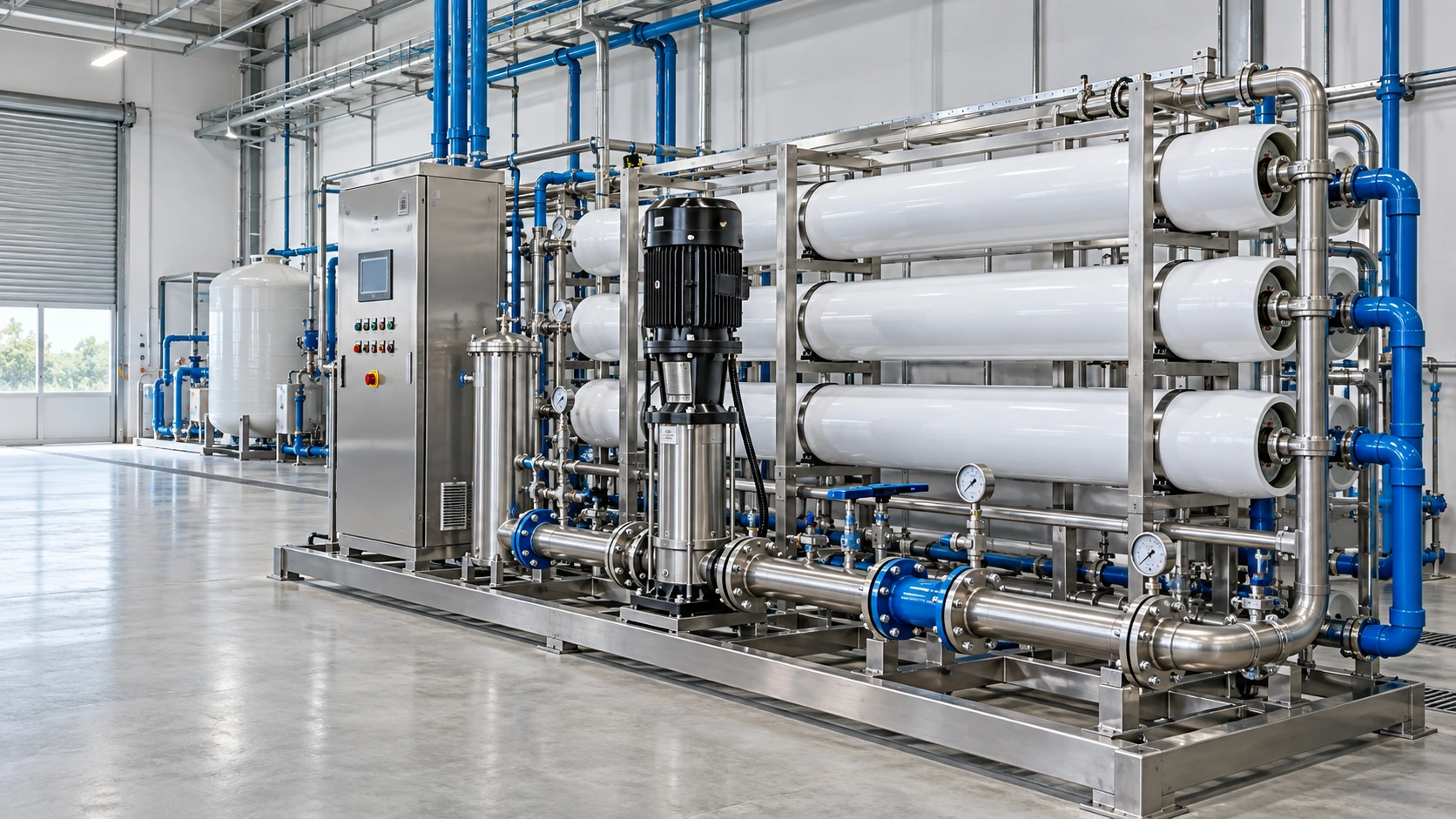
Industrial reverse osmosis membrane skid, pump and control cabinet — illustrative visual

EVERKLIN / WATER TREATMENT

Protect the membrane path. Keep cleaning separate.

Protect membrane performance by connecting feed-water conditioning, membrane protection and planned cleaning to the actual RO system.

6 programme families · Site-specific selection review

Everklin Living Process Platform

RO membrane system

Select a challenge or system component to see where membrane performance is affected and how the relevant treatment programme is assessed.

Process stateNORMAL OPERATION
Realistic three-dimensional reverse osmosis system with pretreatment, dosing, membrane train and CIP loop
System overviewMineral deposition risk on the concentrate side

Select any numbered process point to inspect its operating challenge and treatment context.

Process stages
Monitoring referencesNo live plant values are shown.
Feed ConductivityFeed pHDifferential PressurePermeate FlowRecoveryPermeate Conductivity
+1 more
SDI
Treatment family

Everklin programme

Final selection is coordinated through the single technical review at the end of this page.

TECHNICAL REFERENCE

Understand the system before selecting treatment.

System fundamentals & operating path

Reverse osmosis is a pressure-driven membrane separation process in which feed water is forced through a semipermeable membrane.

Water passes through the membrane while dissolved constituents are preferentially retained in the concentrate stream.

  1. Feed water
  2. Pretreatment
  3. Membrane protection
  4. RO separation
  5. Permeate & concentrate
  6. Offline cleaning when justified

As water becomes permeate, rejected constituents concentrate in the remaining stream. Recovery, pH, temperature, individual ion concentrations and concentration polarization determine the local risk. Two waters with the same TDS can behave very differently: sodium chloride does not indicate the calcium, alkalinity, sulfate, silica, barium or strontium available to form a deposit.

Feed water
Water entering the RO system after applicable pretreatment.
Pretreatment
Upstream conditioning that helps prepare water for the membrane train.
High-pressure pump
Hydraulic pressure provides the driving force for membrane separation.
RO membrane
The semipermeable membrane allows water transport while retaining a substantial fraction of dissolved constituents.
Permeate
The product-water stream passing through the membrane.
Concentrate
The stream containing increased concentrations of rejected constituents.

Reverse osmosis · CONNECTED WORKSPACE

Find the right treatment programme.

Start with the operating problem, review the evidence, understand what should be checked, and explore the relevant Everklin treatment programme in one connected workspace.

  1. System
  2. Problem
  3. Evidence
  4. Check
  5. Treatment
  6. Programme

SELECTED PROBLEM

High hardness & calcium carbonate scale

Calcium and carbonate can precipitate as concentration and carbonate saturation rise along the membrane array.

What you may notice

Declining normalized permeate flow, increasing pressure and deposits toward the concentrate end. These signs alone do not identify the mineral.

Possible contributors

Hardness breakthrough, high alkalinity, elevated pH, increased recovery or interrupted conditioning.

What we would review

  • Measure calcium
  • total hardness
  • alkalinity
  • pH
  • temperature
  • review softener operation
  • a complete feed/concentrate scaling projection

Treatment approach

Restore pretreatment, review recovery and assess pH adjustment and membrane-compatible antiscalant against the concentrate conditions.

Mechanism, monitoring & limitations

Mechanism

Threshold-inhibition and crystal-modification chemistries, including suitable phosphonate or polymer families, require formulation-specific compatibility and scaling assessment.

Monitor

Hardness leakage, pH, recovery, dosing delivery and normalized flow/pressure trends.

Compare normalized performance and deposit recurrence over a stable operating period after correcting the cause.

Limitations

A confirmed carbonate deposit may justify an approved acidic cleaning procedure within the membrane manufacturer’s limits—not a universal acid recipe.

Exact selection and operating limits require current technical documentation and site-specific review.

Why it matters & information needed
Why it matters
Loss of permeability, additional pressure demand and repeated cleaning; persistent deposits can damage performance.
Information needed for assessment
Feed analysis, recovery, membrane type, stage layout, conditioning history and cleaning records.
  1. System
  2. Problem
  3. Evidence
  4. Check
  5. Treatment
  6. Programme

SELECTED PROBLEM

Calcium, barium & strontium sulfate scale

Different sulfate salts reach saturation at different conditions; trace barium or strontium can be important even when bulk hardness is modest.

What you may notice

Persistent tail-stage deposits, falling normalized flow and incomplete recovery after routine cleaning.

Possible contributors

Concentration of sulfate with calcium, barium or strontium; source-water change or recovery beyond the assessed operating envelope.

What we would review

  • Assess CaSO₄
  • BaSO₄
  • SrSO₄ separately using calcium
  • sulfate
  • barium
  • strontium results
  • temperature
  • actual recovery

Treatment approach

Evaluate recovery reduction, appropriate pretreatment and a treatment specifically validated for the relevant sulfate saturation.

Mechanism, monitoring & limitations

Mechanism

Compatible antiscalant families with demonstrated sulfate-control capability; a generic chemistry description is not proof of performance.

Monitor

Source chemistry, concentrate conditions, delivery reliability and stage-specific normalized differential pressure.

Review a new scaling projection and trend stable operation; identify deposits where feasible.

Limitations

Obtain deposit-specific membrane cleaning advice. Barium and strontium sulfate are particularly difficult; acid cleaning must not be assumed effective.

Exact selection and operating limits require current technical documentation and site-specific review.

Why it matters & information needed
Why it matters
Hard-to-remove deposits and loss of membrane capacity. Carbonate control alone does not establish sulfate protection.
Information needed for assessment
Full ion analysis including trace barium/strontium, projection, stages, recovery and failed cleaning history.
  1. System
  2. Problem
  3. Evidence
  4. Check
  5. Treatment
  6. Programme

SELECTED PROBLEM

Reactive silica, silicates & mixed silica deposits

Dissolved silica can become concentrated; colloidal silica and metal-silicate deposits present different treatment and cleaning problems.

What you may notice

Persistent loss of normalized flow or a deposit that does not respond to the existing cleaning sequence.

Possible contributors

High reactive silica, increased recovery, changed pH or temperature, and interaction with iron or aluminium carryover.

What we would review

  • Distinguish reactive
  • total silica
  • check iron
  • aluminium
  • pH
  • temperature
  • recovery
  • pretreatment carryover

Treatment approach

Assess concentrate silica, pretreatment removal options, recovery and a silica-specific compatibility review.

Mechanism, monitoring & limitations

Mechanism

Specialized silica-control or dispersion approaches are conditional on the actual formulation and water chemistry.

Monitor

Silica, metal carryover, concentrate pH/temperature and normalized membrane performance.

Confirm deposit composition and compare normalized performance and recurrence after corrective action.

Limitations

Specialty silica or staged cleaning requires manufacturer review. Do not raise pH or temperature beyond membrane limits.

Exact selection and operating limits require current technical documentation and site-specific review.

Why it matters & information needed
Why it matters
Tenacious deposits and difficult cleaning; a generic antiscalant cannot be assumed to control every silica condition.
Information needed for assessment
Reactive/total silica, iron/aluminium, recovery projection, membrane limits and previous cleaning response.
  1. System
  2. Problem
  3. Evidence
  4. Check
  5. Treatment
  6. Programme

SELECTED PROBLEM

High TDS, increased recovery & reduced output

Higher salinity raises osmotic pressure; higher recovery further concentrates the reject stream and can increase several scaling risks.

What you may notice

Higher operating pressure, reduced permeate flow or greater concentrate conductivity.

Possible contributors

A new feed source, excessive recovery, flow-meter error, concentrate restriction or operation outside the design envelope.

What we would review

  • Check calibrated flows
  • conductivity in all three streams
  • temperature
  • pressure
  • complete ionic analysis

Treatment approach

Reconcile the water balance and assess the membrane projection before changing recovery, pressure or conditioning.

Mechanism, monitoring & limitations

Mechanism

Antiscalants address suitable mineral risks; they do not remove TDS or eliminate osmotic pressure.

Monitor

Feed/permeate/concentrate flows, recovery, conductivity, pressures, temperature and normalized output.

Compare normalized, not raw, flow and rejection against the baseline at documented conditions.

Limitations

Clean only when fouling evidence warrants it; salinity or temperature changes alone are not a cleaning diagnosis.

Exact selection and operating limits require current technical documentation and site-specific review.

Why it matters & information needed
Why it matters
Increased energy demand, concentration polarization and scaling; pushing pressure is not a substitute for checking design constraints.
Information needed for assessment
Design and actual flows, source analysis, projection, membrane age/model and operating log.
  1. System
  2. Problem
  3. Evidence
  4. Check
  5. Treatment
  6. Programme

SELECTED PROBLEM

Iron fouling

Dissolved iron can oxidize into particles; corrosion debris and upstream iron-treatment carryover can also foul membranes.

What you may notice

Discoloured cartridges or deposits, rising differential pressure and lower normalized flow.

Possible contributors

Source-water iron, air ingress, oxidant exposure, corroding pipework or ineffective filtration.

What we would review

  • Compare dissolved
  • total iron across pretreatment
  • examine oxidation conditions
  • cartridges
  • deposit analysis

Treatment approach

Correct iron removal or corrosion carryover upstream and review filtration before relying on membrane treatment.

Mechanism, monitoring & limitations

Mechanism

Pretreatment oxidation/removal and compatible dispersing or cleaning families serve different roles; selection is water- and membrane-specific.

Monitor

Iron breakthrough, turbidity, cartridge life and stage pressure losses.

Demonstrate improved upstream removal and sustained normalized membrane recovery.

Limitations

Use an iron-deposit cleaning method approved for the membrane; mixed iron/silica deposits need separate evaluation.

Exact selection and operating limits require current technical documentation and site-specific review.

Why it matters & information needed
Why it matters
Blockage, mixed deposits and increased sensitivity to oxidant exposure under some conditions.
Information needed for assessment
Iron fractions, pipe metallurgy, pretreatment sequence, oxidant history and deposit photos.
  1. System
  2. Problem
  3. Evidence
  4. Check
  5. Treatment
  6. Programme

SELECTED PROBLEM

Manganese fouling

Manganese compounds can precipitate or pass through poorly controlled upstream removal stages.

What you may notice

Dark deposits, short cartridge life, rising pressure loss or reduced normalized output.

Possible contributors

Changing source-water manganese, oxidation conditions or filter breakthrough.

What we would review

  • Measure manganese before
  • after pretreatment
  • review oxidant dosing
  • filtration
  • backwash operation

Treatment approach

Stabilize upstream manganese removal and confirm oxidant removal before the membrane.

Mechanism, monitoring & limitations

Mechanism

Oxidation/filtration may be relevant upstream; membrane cleaning chemistry must be separately verified.

Monitor

Manganese residual, turbidity, oxidant residual and stage differential pressure.

Confirm removal across pretreatment and inspect cleaning response against normalized trends.

Limitations

Identify the deposit and use the membrane manufacturer’s compatible cleaning guidance.

Exact selection and operating limits require current technical documentation and site-specific review.

Why it matters & information needed
Why it matters
Persistent particulate loading and mixed deposits on membrane surfaces.
Information needed for assessment
Manganese analysis, oxidant and filter records, membrane model and cleaning history.
  1. System
  2. Problem
  3. Evidence
  4. Check
  5. Treatment
  6. Programme

SELECTED PROBLEM

Aluminium carryover & coagulant fouling

Residual aluminium and coagulant carryover can form deposits or interact with silica and other treatment chemicals.

What you may notice

Rapid cartridge loading and fouling following a pretreatment chemistry change.

Possible contributors

Unsuitable coagulation pH, poor solids separation, excessive coagulant feed or changing raw-water demand.

What we would review

  • Measure residual aluminium
  • silica
  • turbidity
  • SDI
  • review jar tests
  • coagulant/antiscalant compatibility

Treatment approach

Optimize coagulation and filtration; prevent carryover and review compatibility before selecting membrane protection.

Mechanism, monitoring & limitations

Mechanism

Pretreatment coagulants and membrane antiscalants cannot be considered independently where residual interactions are possible.

Monitor

Residual aluminium, SDI, filter performance and normalized flow/pressure.

Confirm lower carryover and sustained membrane performance after a controlled adjustment.

Limitations

Mixed aluminium/silica fouling needs deposit-specific review and a membrane-compatible sequence.

Exact selection and operating limits require current technical documentation and site-specific review.

Why it matters & information needed
Why it matters
Mixed foulants, pressure rise and difficult cleaning even when the raw-water TDS appears normal.
Information needed for assessment
Coagulant details, jar tests, aluminium/silica data, filtration history and membrane limits.
  1. System
  2. Problem
  3. Evidence
  4. Check
  5. Treatment
  6. Programme

SELECTED PROBLEM

Colloids, high SDI & short cartridge life

Fine particles and colloids accumulate in cartridges and membrane feed channels; turbidity and SDI describe different aspects of the feed.

What you may notice

Frequent cartridge changes, rising leading-stage differential pressure and increased feed pressure.

Possible contributors

Filter breakthrough, poorly conditioned raw water, disturbed media, source events or upstream corrosion.

What we would review

  • Trend SDI
  • turbidity
  • cartridge pressure drop
  • filter backwash
  • compare samples along the pretreatment train

Treatment approach

Correct pretreatment and filtration selection, integrity and operation before changing chemical protection.

Mechanism, monitoring & limitations

Mechanism

Upstream coagulation/flocculation may assist removal when tested; residual coagulant must remain compatible with RO operation.

Monitor

SDI/turbidity, cartridge life and stage pressure losses at comparable flow.

Confirm improved filtrate quality and longer stable operation without relying on one clear sample.

Limitations

A manufacturer-approved colloidal-fouling cleaning sequence may be needed after pretreatment is corrected.

Exact selection and operating limits require current technical documentation and site-specific review.

Why it matters & information needed
Why it matters
Flow maldistribution, fouling and shortened cleaning intervals; antiscalant does not replace solids removal.
Information needed for assessment
Filter design, media/backwash records, particle/SDI trends, cartridge grade and replacement history.
  1. System
  2. Problem
  3. Evidence
  4. Check
  5. Treatment
  6. Programme

SELECTED PROBLEM

Organic, oil & surfactant fouling

Organic material can adsorb on membranes or form mixed deposits; oils and surfactants may alter surface behaviour and support biological growth.

What you may notice

Reduced normalized flow, sticky deposits, changing rejection or recurring cleaning demand.

Possible contributors

Process leakage, contaminated source water, pretreatment breakthrough or incompatible upstream chemical addition.

What we would review

  • Review TOC/COD where relevant
  • oil
  • grease
  • process contamination
  • recent treatment changes

Treatment approach

Isolate the contamination source and assess pretreatment removal and membrane compatibility.

Mechanism, monitoring & limitations

Mechanism

Compatible alkaline cleaners and surfactant/chelating cleaning systems may be considered by foulant type; these are not routine antiscalants.

Monitor

Organic loading, oil carryover and normalized membrane performance.

Demonstrate reduced incoming load and a sustained post-cleaning trend.

Limitations

Select an approved organic-fouling or staged procedure; avoid unverified solvent or surfactant exposure.

Exact selection and operating limits require current technical documentation and site-specific review.

Why it matters & information needed
Why it matters
Mixed organic/biological fouling and persistent permeability loss.
Information needed for assessment
Source/process history, organic analysis, membrane model, deposits and past cleaning results.
  1. System
  2. Problem
  3. Evidence
  4. Check
  5. Treatment
  6. Programme

SELECTED PROBLEM

Biofouling, slime & EPS

Microorganisms attach to wetted surfaces and form an extracellular polymeric substance (EPS) matrix that traps material.

What you may notice

Slime, rising leading-stage pressure loss, recurrent fouling and lower normalized flow.

Possible contributors

Nutrients, warm water, stagnant zones, pretreatment contamination and ineffective sanitation.

What we would review

  • Inspect pretreatment
  • dead legs
  • assess appropriate microbial indicators
  • deposits rather than relying only on bulk-water counts

Treatment approach

Reduce upstream nutrients and contamination; coordinate compatible microbial control, matrix removal and sanitation.

Mechanism, monitoring & limitations

Mechanism

Biocide controls organisms; biodispersant helps release attached material; membrane cleaner removes fouling. These functions are not interchangeable and each requires compatibility approval.

Monitor

Microbial indicators, pretreatment condition, differential pressure and cleaning recurrence.

Check both microbial control and sustained hydraulic recovery after treatment.

Limitations

Use an approved biological/organic cleaning and sanitation sequence. Killing organisms alone does not remove EPS.

Exact selection and operating limits require current technical documentation and site-specific review.

Why it matters & information needed
Why it matters
Persistent pressure loss and rapid recolonization if the source and attached matrix remain.
Information needed for assessment
Microbial results, pretreatment layout, sanitation history, membrane limits and pressure trends.
  1. System
  2. Problem
  3. Evidence
  4. Check
  5. Treatment
  6. Programme

SELECTED PROBLEM

High differential pressure, low flow or poor salt rejection

Hydraulic blockage, permeability loss and salt passage are separate performance indicators; one symptom can have several causes.

What you may notice

Stage pressure loss, lower permeate production, rising permeate conductivity or repeated adjustments to pressure.

Possible contributors

Scale/fouling, temperature or salinity change, instrument drift, damaged seals, mechanical defects or membrane oxidation.

What we would review

  • Normalize flow
  • pressure loss
  • rejection
  • calibrate sensors
  • inspect stage trends
  • check seals
  • pressure limits

Treatment approach

Separate instrument/hydraulic faults from deposits and integrity loss before recommending chemistry or cleaning.

Mechanism, monitoring & limitations

Mechanism

Treatment families address identified scale, biological or organic causes; no chemical restores every damaged membrane.

Monitor

Feed/permeate/concentrate pressures, flows and conductivities; temperature, recovery and normalized trends.

Compare a documented baseline at comparable operating conditions and confirm permeate quality.

Limitations

Use manufacturer cleaning triggers and foulant identification; investigate poor recovery after cleaning before repeating it.

Exact selection and operating limits require current technical documentation and site-specific review.

Why it matters & information needed
Why it matters
Misdiagnosis can lead to unnecessary cleaning or conceal membrane damage and poor water quality.
Information needed for assessment
Daily logs, baseline, membrane age/model, seal history, analysis and cleaning response.
  1. System
  2. Problem
  3. Evidence
  4. Check
  5. Treatment
  6. Programme

SELECTED PROBLEM

Chlorine breakthrough & dechlorination control

Oxidant exposure can damage susceptible membrane materials. A reducing-agent dose must be linked to the actual oxidant demand and mixing conditions.

What you may notice

Detectable chlorine at membrane feed or unexplained rejection deterioration; damage may occur without visible deposits.

Possible contributors

Upstream disinfection changes, carbon exhaustion, underfeed, pump failure or inadequate contact before the membrane.

What we would review

  • Measure the relevant chlorine residual directly
  • inspect the dosing point
  • verify membrane oxidant compatibility

Treatment approach

Correct removal, mixing and delivery; review alarms/interlocks and treatment demand with the membrane supplier.

Mechanism, monitoring & limitations

Mechanism

Suitable reducing-agent families or upstream adsorption can remove oxidants under assessed conditions. No universal dose is specified.

Monitor

Direct residual chlorine, ORP as supporting context, flow, tank level and verified pump delivery.

Confirm absence of incompatible residual at the membrane inlet using appropriate testing; review normalized rejection.

Limitations

Cleaning does not reverse chemical oxidation damage; assess integrity and replacement needs separately.

Exact selection and operating limits require current technical documentation and site-specific review.

Why it matters & information needed
Why it matters
Irreversible membrane damage. Excess reducing agent can also disturb downstream conditions and does not prove better protection.
Information needed for assessment
Oxidant type/residual, feed flow, dosing arrangement, membrane tolerance and event history.
  1. System
  2. Problem
  3. Evidence
  4. Check
  5. Treatment
  6. Programme

SELECTED PROBLEM

Frequent CIP & deposit-specific cleaning

Repeated cleaning indicates unresolved loading, operating conditions, unsuitable chemistry or an ineffective cleaning sequence.

What you may notice

Shorter run length, incomplete normalized-flow recovery or rapid return of pressure loss.

Possible contributors

Persistent upstream breakthrough, late cleaning, mixed deposits, poor circulation or incompatible cleaning conditions.

What we would review

  • Identify deposit composition
  • compare pre/post-CIP normalized data
  • inspect solution temperature
  • pH
  • flow
  • cleaning records

Treatment approach

Fix the upstream cause and prepare a manufacturer-compatible deposit-specific plan with acceptance criteria.

Mechanism, monitoring & limitations

Mechanism

Acidic cleaning for suitable mineral deposits; alkaline systems for suitable organic/biological foulants; specialist silica or multi-stage cleaning only after review.

Monitor

Cleaning conditions, rinse endpoint, stage pressure losses and post-cleaning normalized operation.

Assess restored performance, permeate quality and time to the next cleaning—not simply a cleaner-looking solution.

Limitations

No universal sequence, dose, pH, temperature or contact time applies. Respect membrane, seals, equipment and waste-handling limits.

Exact selection and operating limits require current technical documentation and site-specific review.

Why it matters & information needed
Why it matters
Repeated unsuitable cleaning can compound performance loss and consume water, chemicals and downtime.
Information needed for assessment
Membrane specifications, deposit analysis, CIP equipment, complete cleaning logs and run-length history.
System-wide selection & operating evidence

This educational framework organizes the information required before a chemistry area and product route are assessed.

Water quality

  • pH
  • Conductivity
  • TDS
  • Calcium
  • Magnesium
  • Alkalinity
  • Sulfate
  • Chloride
  • Silica
  • Barium
  • Strontium
  • Iron
  • Aluminium
  • Temperature
  • Microbiological condition
  • Organic loading

RO operating data

  • Feed flow
  • Permeate flow
  • Concentrate flow
  • Recovery
  • Feed pressure
  • Concentrate pressure
  • Differential pressure
  • Permeate conductivity
  • Salt rejection
  • Temperature

Membrane / system data

  • Manufacturer
  • Membrane model
  • Membrane type
  • Number of stages
  • Number of elements
  • Configuration
  • Current chemistry
  • Cleaning history
  • Operating history

Water profile

  • Complete feed-water analysis
  • Pretreatment and oxidant condition
  • Temperature and organic or microbial loading

Membrane system

  • Membrane type and configuration
  • Stages, recovery and concentrate condition
  • Material compatibility and manufacturer guidance

Operating evidence

  • Flows, pressures and differential pressure
  • Permeate quality and salt rejection
  • Cleaning history and observed deposits

Programme objective

  • Online protection or offline cleaning
  • Required monitoring and dosing point
  • Current documentation and site procedure

Everklin reviews the water profile, membrane train, operating data and identified foulant or scale risk before defining the appropriate chemistry family, cleaning route and control requirement.

  1. Analyse feed water
  2. Review the membrane train
  3. Identify the treatment risk
  4. Define and validate the programme

Monitoring & baseline

Compare current performance with a representative baseline at documented operating conditions.

Feed Conductivity

  • Review against the current operating record and active treatment objective.

Feed pH

  • Review against the current operating record and active treatment objective.

Differential Pressure

  • Review against the current operating record and active treatment objective.

Permeate Flow

  • Review against the current operating record and active treatment objective.

Recovery

  • Review against the current operating record and active treatment objective.

Permeate Conductivity

  • Review against the current operating record and active treatment objective.
Plant & operating conditions
  • Capacity / feed flow
  • Water source
  • Recovery
  • Membrane manufacturer and model
  • Stages and element configuration
  • Operating temperature
  • Feed / permeate / concentrate pressures
  • Feed / permeate / concentrate flows
  • Feed / permeate / concentrate conductivity
Water analysis (include units)
  • pH
  • TDS
  • Total hardness
  • Calcium
  • Alkalinity
  • Silica (reactive / total)
  • Sulfate
  • Chloride
  • Iron
  • Manganese
  • Aluminium
  • Barium
  • Strontium
  • Turbidity
  • SDI
  • Residual chlorine
  • ORP
Treatment & history
  • Current treatment and dosage
  • Dosing / pretreatment arrangement
  • CIP frequency and cleaning method
  • Normalized performance / cleaning response

NEED HELP? GET EXPERT SUPPORT

Share your operating data.

Let our technical team review the evidence and appropriate programme route.

Request technical assessment

UPLOAD YOUR WATER ANALYSIS

Attach your latest report.

PDF, JPG or PNG files already supported by the secure assessment form.

Upload file →

Possible causes are not a diagnosis. Educational chemistry families do not confirm product availability. Exact treatment, compatibility and operating limits require site-specific technical review.

DOCUMENTATION & TECHNICAL SUPPORT

Keep the decision connected to evidence.

Request the current TDS, SDS or technical-assessment support for the RO chemistry area under review.

Reverse osmosis technical questions
Why is TDS alone insufficient for antiscalant selection?

TDS combines many dissolved constituents into one result. Calcium, alkalinity, sulfate, silica, barium and strontium must be assessed individually at the actual recovery, pH and temperature. A concentrate-side projection and membrane compatibility review are needed.

How does higher recovery increase scaling risk?

Removing more permeate concentrates rejected constituents. Local membrane-surface conditions can differ from the bulk concentrate. Increasing recovery therefore requires a new scaling and hydraulic assessment, not simply a larger chemical dose.

Can one antiscalant control every type of scale?

No universal capability should be assumed. Carbonate, calcium sulfate, barium/strontium sulfate and silica risks need separate evaluation against formulation-specific performance evidence.

Why does silica need a separate review?

Reactive silica, colloidal silica and metal-silicate deposits behave differently. Iron/aluminium, pH, temperature and recovery influence both prevention and cleaning; generic carbonate control is not evidence of silica protection.

Is a biocide the same as a biodispersant?

No. Biocide controls susceptible organisms; biodispersant assists release of attached material. A compatible cleaning method may still be required to remove EPS and deposits.

Does microbial killing remove membrane biofilm?

Not necessarily. Dead organisms and the attached matrix may remain. Address nutrients and contamination upstream, then coordinate compatible microbial control with deposit removal and verification.

Can ORP replace residual chlorine testing?

No universal substitution is valid. ORP is influenced by several chemical conditions. Use an appropriate direct chlorine-residual test at the membrane feed and verify the membrane’s oxidant limits.

When is acidic versus alkaline cleaning appropriate?

The deposit and membrane limits determine the method. Suitable mineral deposits may respond to acidic systems; suitable organic or biological foulants may require alkaline systems. Silica or mixed deposits can need specialist or staged review.

Why does differential pressure increase?

Particles, biofilm or deposits can obstruct feed channels; changed flow and instrument error can also affect readings. Compare stage-specific pressure loss at normalized conditions before deciding to clean.

What can cause low permeate flow?

Temperature, salinity, pressure, recovery and fouling all influence flow. Normalize the trend and check pretreatment and equipment before treating every flow reduction as scaling.

What can cause poor salt rejection?

Fouling, oxidant damage, sealing defects, operating changes or measurement errors may contribute. Check conductivity and flow measurements, normalize performance and review membrane integrity. Cleaning cannot reverse every form of damage.

Why is cleaning needed again so soon?

The incoming foulant source, pretreatment, operating envelope or cleaning method may remain unsuitable. Compare deposits and pre/post-cleaning normalized data and correct the root cause.

What should I send for an RO assessment?

Send a complete water analysis, membrane/configuration details, recovery and flow/pressure/conductivity trends, pretreatment and current treatment, plus cleaning records. Include units, sampling locations and operating conditions.

Request Technical Review

Review the operating context before programme selection.

Share your operating conditions, current treatment context and available process or water data. Everklin's technical team can review the relevant programme.

Request Technical Review