
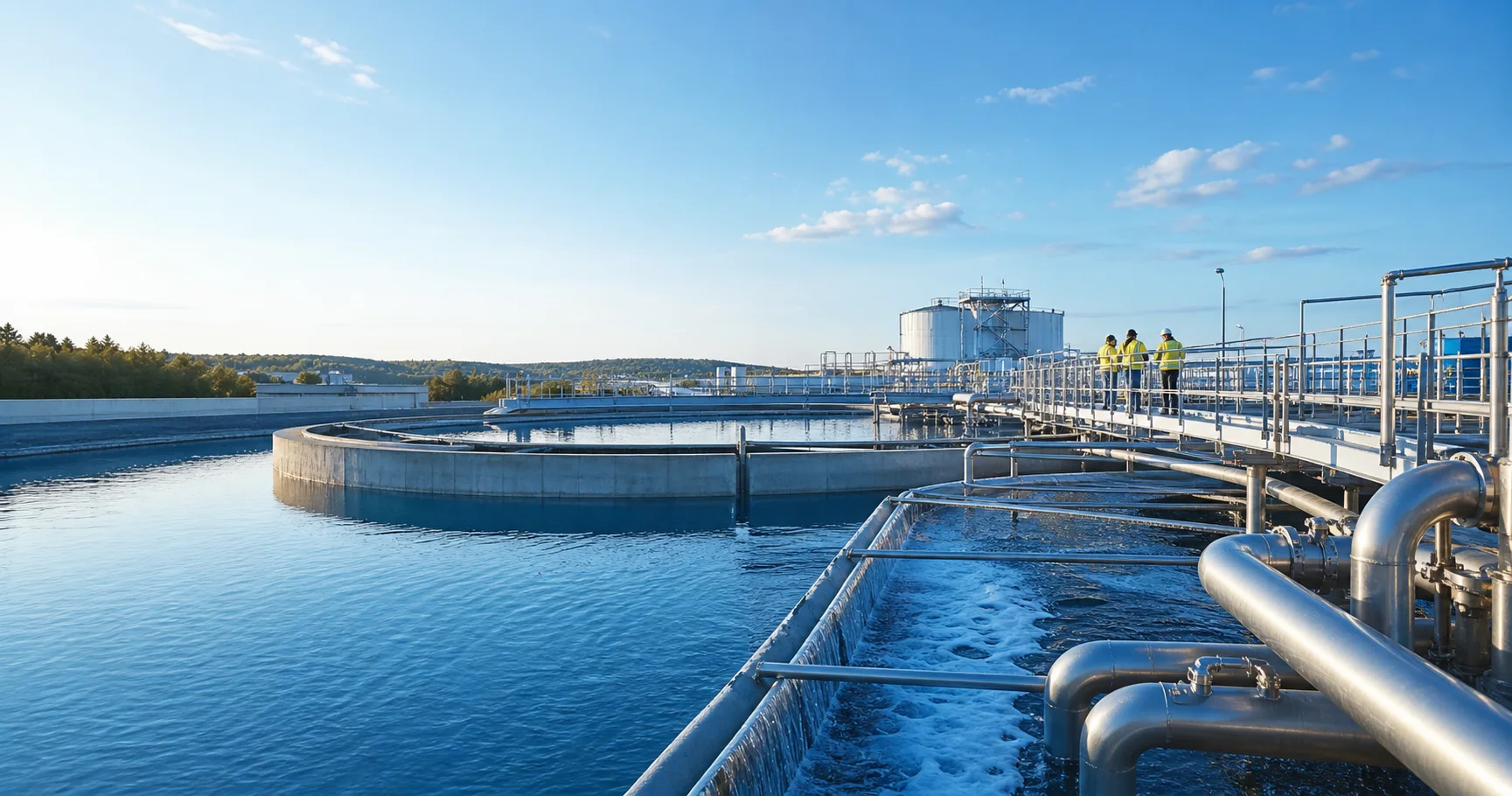
Influent and equalisation
Review the incoming effluent pattern and how variation is managed before treatment.
Connect influent condition, chemical treatment, solids separation and biological support to the actual effluent-treatment sequence.

An ETP programme follows the actual influent, equalisation, pH adjustment, physical-chemical treatment, biological stage where applicable, polishing and solids route.
This workspace helps connect a treatment requirement to the correct process zone. It does not automatically prescribe chemistry, dosage or discharge performance.
Review the incoming effluent pattern and how variation is managed before treatment.
Locate pH control within the actual operating sequence and current evidence.
Connect destabilisation chemistry to the selected separation route.
Review floc formation, separation and the downstream solids path together.
Keep biological-support discussion tied to the configured plant and operating condition.
Consider colour, foam, final treatment and solids handling at their actual process points.
Treatment selection, discharge decisions and any use of chemistry require a site-specific technical review and approved operating procedure.
The diagram maps each programme to its relevant treatment stage or process-support point.
The workspace keeps pH, solids separation, colour, foam and biological treatment connected to the operating sequence rather than presenting a universal product answer.
The treatment path should start with the actual influent profile, collection route and equalisation capacity. The rest of the treatment sequence is interpreted in that context.
Equalisation is reviewed with the source of variation, tank operation, mixing arrangement and the downstream treatment sequence.
pH Correctors are reviewed against the influent, operating sequence, available measurement and the chemistry that follows. A hard-coded injection point is not assumed.
pH control should be linked to a measured process condition and an approved operating procedure.
Coagulation and flocculation are reviewed as part of a selected separation sequence with clarification and solids handling in view.
Coagulants are considered with pH, suspended matter, mixing, clarification arrangement and the current technical evidence.
Flocculant review follows the selected coagulation step, flocculation conditions, clarification arrangement and the resulting sludge path.
A visible floc is not the only evidence used to judge a treatment route.
Colour reduction and foam control are application-dependent. The treatment point should be tied to the current process condition, related separation chemistry and operating procedure.
Decolorants are reviewed with current effluent condition, the separation sequence and the selected process point. No fixed result or performance outcome is assumed.
Defoamers are reviewed at the zone where foam is observed, together with the treatment chemistry and operating condition that may be contributing to it.
Foam control is an application review, not a default addition to every ETP programme.
Where a biological stage is part of the configured plant, it is reviewed with the influent route, aeration or biological process, clarification and the associated solids path.
Biological Nutrients are reviewed only in the context of the existing biological treatment route, operating evidence and current technical documentation.
A biological-treatment discussion requires plant-specific context before any programme is considered.
Clarifier underflow, solids handling and any downstream arrangement should remain visible when the physical-chemical or biological route is reviewed.
Use the observed treatment condition to open the relevant process area. These routes do not automatically recommend a chemistry programme.
A responsible process review connects influent, equalisation, pH, physical-chemical treatment, biological treatment where applicable, polishing and solids handling.
| Potential condition | Primary technical area | Assessment focus |
|---|---|---|
| Variable influent | Influent Conditioning | Confirm collection, equalisation and the treatment sequence. |
| pH-related concern | Influent Conditioning | Confirm the measured process point and chemistry that follows. |
| Poor solids separation | Physical-Chemical Separation | Review coagulation, flocculation, clarification and solids route. |
| Colour or foam | Colour, Foam and Polishing | Locate the observed condition in the operating sequence. |
| Biological-stage concern | Biology and Solids | Confirm plant configuration and current operating evidence. |
This is an educational process framework, not a discharge-performance guarantee or automatic chemical recommendation.
Monitoring depends on the configured ETP, process condition, site procedure and the information available for technical review.
Each item below is part of the approved public ETP Chemicals architecture. Technical information is requested against the actual plant and treatment point.
Measured pH-control-point context.
Request technical information →Physical-chemical separation context.
Request technical information →Flocculation, clarification and solids-route context.
Request technical information →Selected clarification or polishing context.
Request technical information →Observed foam location and process context.
Request technical information →Configured biological-treatment context where applicable.
Request technical information →Documentation is requested with the appropriate ETP programme area and plant context so the technical review remains connected to the treatment sequence.
The incoming effluent and its variation shape the context for equalisation and the treatment sequence that follows.
They are related but distinct parts of a physical-chemical separation sequence and are reviewed with clarification and solids handling.
The right control point depends on the real treatment sequence, available measurement and the chemistry that follows.
They may appear at different process zones and can have different operating causes and treatment context.
No. Biological-support discussion depends on the configured plant and the actual biological-treatment context.
Useful information includes plant configuration, influent context, treatment sequence, current observations and existing programme documentation.
Share the treatment sequence, current operating condition, available evidence and documentation need for an application-led ETP review.