
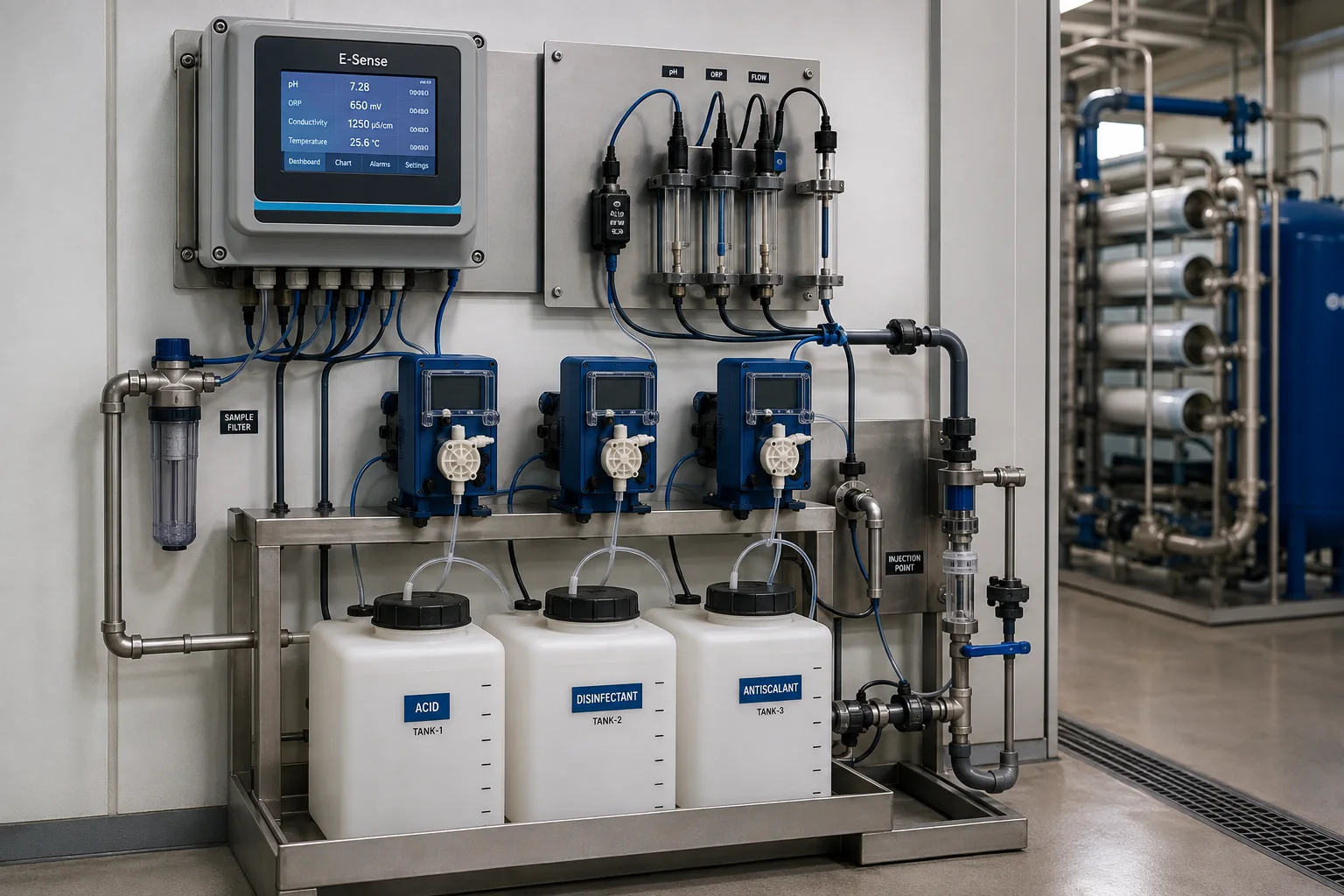
Industrial online dosing installation with Process controller, sensors, metering pumps and chemical tanks

EVERKLIN / WATER TREATMENT

Measure the system. Connect the feed decision.

Connect measurement, controller logic and chemical feed to the process point they are designed to control.

6 programme families · Site-specific selection review

Everklin Living Process Platform

Process measurement and dosing logic

Explore the illustrative control sequence from measurement to verification. No live customer telemetry or plant status is shown.

Process stateNORMAL OPERATION
Illustrative System Logic
Realistic three-dimensional online dosing and monitoring system with controller, sensors, tanks, pumps and process loop
System overviewMeasured conductivity informing bleed response

Select any numbered process point to inspect its operating challenge and treatment context.

Process stages
Monitoring referencesNo live customer telemetry is shown.
ConductivityPump StatusTank LevelFlow PulseDosing ModeBleed Status
+1 more
Alarm Status
Treatment family

Everklin programme

Final selection is coordinated through the single technical review at the end of this page.

TECHNICAL REFERENCE

Understand the system before selecting treatment.

System fundamentals & operating path

A useful online dosing system connects the process measurement, sensor signal, controller decision, chemical tank, metering pump, injection point and operating verification.

This workspace explains that architecture. It does not determine a controller model, set point or chemical-feed rate without a system-specific review.

  1. Representative sample
  2. Calibrated measurement
  3. Reviewed control logic
  4. Chemical / bleed action
  5. Independent verification
  6. Operator response

An online reading is not proof of chemical delivery or treatment success. Keep sensor calibration, pump calibration, sample flow, tank condition and independent water testing in the same operating procedure. These diagrams illustrate control logic; they do not claim a connected live plant, cloud platform or remote monitoring service.

Measure
Start with the parameter, process location and condition that need to be observed.
Signal
Connect the sensor and its installation to the controller input.
Decide
Review controller logic, alarms and response in the context of the process.
Deliver
Keep chemical tank, pump and injection arrangement connected to the selected control logic.
Inject
Confirm the actual injection point and downstream process zone.
Verify
Use operating observations and trend data to support technical follow-up.

Monitoring & dosing · CONNECTED WORKSPACE

Find the right monitoring & dosing approach.

Start with the control requirement, review what should be measured, and connect the response logic to a supported equipment configuration.

  1. System
  2. Problem
  3. Evidence
  4. Check
  5. Treatment
  6. Programme

CONTROL REQUIREMENT

Conductivity-controlled blowdown

A conductivity measurement can inform blowdown when it represents circulating-water concentration accurately.

What you may notice

High cycles, excessive makeup use or disagreement with grab samples.

Possible contributors

Sensor fouling, poor sampling, unsuitable setpoint or a bleed valve that does not respond.

What we would review

  • Calibrate the probe
  • check temperature compensation/sample flow
  • verify valve movement
  • makeup/blowdown meters

Control logic & dosing approach

Set the control envelope from limiting chemistry and validate the complete measurement-to-valve chain.

Verification, monitoring & limitations

Mechanism

Blowdown complements scale/corrosion control; it is not a chemical treatment and cannot distinguish every contaminant.

Monitor

Conductivity, relevant ions, meter totals and actual bleed response.

Reconcile cycles and water balance against independent samples.

Limitations

Use approved probe cleaning and valve maintenance procedures.

Exact selection and operating limits require current technical documentation and site-specific review.

Why it matters & information needed
Why it matters
Overconcentration or wasted water and treatment.
Information needed for assessment
Water analyses, target cycles, flow data, probe/valve details and wiring/control requirements.
  1. System
  2. Problem
  3. Evidence
  4. Check
  5. Treatment
  6. Programme

CONTROL REQUIREMENT

Flow-proportional & water-meter pulse feed

A measured flow or meter pulse can scale chemical delivery to changing throughput.

What you may notice

Dose changes unrelated to flow or treatment drift during changing demand.

Possible contributors

Incorrect pulse scaling, pump capacity mismatch, air locking, blocked injection or an unreliable flow signal.

What we would review

  • Confirm units
  • pulse factor
  • flow range
  • pump calibration
  • pressure
  • injection arrangement

Control logic & dosing approach

Size the pump and validate signal scaling and actual delivered volume through the normal flow envelope.

Verification, monitoring & limitations

Mechanism

The required concentration remains application-specific; proportional control does not itself choose a dose.

Monitor

Meter totals, pump output, tank use and an independent treatment indicator.

Compare actual delivered volume with expected delivery across representative flows.

Limitations

Service suction/injection components with isolation and chemical-compatible methods.

Exact selection and operating limits require current technical documentation and site-specific review.

Why it matters & information needed
Why it matters
Underfeed or overfeed despite an apparently active controller.
Information needed for assessment
Flow range, meter signal, pump curve, chemical compatibility and injection pressure.
  1. System
  2. Problem
  3. Evidence
  4. Check
  5. Treatment
  6. Programme

CONTROL REQUIREMENT

pH, ORP & residual-based decisions

pH and ORP describe different conditions; ORP is affected by chemistry and cannot universally replace direct oxidant-residual testing.

What you may notice

Oscillation, delayed control or disagreement with laboratory/residual measurements.

Possible contributors

Unrepresentative sample, probe drift, slow mixing or process-demand changes.

What we would review

  • Verify calibration
  • sample response time
  • mixing
  • independent pH/residual
  • permitted chemical interactions

Control logic & dosing approach

Define process-specific control logic, response limits and independent verification with qualified engineering review.

Verification, monitoring & limitations

Mechanism

Neutralization and oxidant/reducing programmes require separate dosing paths and compatibility review.

Monitor

Calibrated pH/ORP, direct residual where applicable, flow and actual delivery.

Confirm the control response at stable and changing demand without assuming a universal ORP target.

Limitations

Clean and maintain probes according to the manufacturer; do not mix maintenance chemicals.

Exact selection and operating limits require current technical documentation and site-specific review.

Why it matters & information needed
Why it matters
Unsafe or ineffective feed from an unvalidated correlation.
Information needed for assessment
Chemistry, water buffering/demand, sample arrangement, controller inputs/outputs and verification method.
  1. System
  2. Problem
  3. Evidence
  4. Check
  5. Treatment
  6. Programme

CONTROL REQUIREMENT

Biocide scheduling, multiple feeds & interlocks

A treatment sequence may require timed feeds, independent channels and safe stop conditions.

What you may notice

Treatment gaps, unexplained tank use or alarms without a clear action.

Possible contributors

Uncoordinated feeds, incompatible chemicals, no-flow dosing, empty tanks or missing operator response.

What we would review

  • Confirm equipment-supported timers
  • outputs
  • tank-level sensing
  • no-flow interlocks
  • permitted channel combinations

Control logic & dosing approach

Document the cause-and-effect matrix, safe states and testing procedure before configuration.

Verification, monitoring & limitations

Mechanism

Biocide timing and chemical compatibility must follow the reviewed treatment and current documentation, not a generic controller schedule.

Monitor

Pump/channel status, actual flow, tank condition, alarms and treatment response.

Witness interlock/fail-state tests under safe commissioning conditions and record operator actions.

Limitations

Maintain each segregated feed path with safe isolation and approved handling.

Exact selection and operating limits require current technical documentation and site-specific review.

Why it matters & information needed
Why it matters
Incompatible dosing or uncontrolled delivery. No unverified feature is assumed available.
Information needed for assessment
Channel count, chemical compatibility, flow signals, alarm needs, wiring and approved equipment capabilities.
System-wide selection & operating evidence

A responsible dosing-system review brings measurement, control logic, chemical delivery, injection point, operating procedure and verification into one system assessment.

A. Process and measurement

  • Required parameter
  • Process location
  • Sensor and installation context
  • Current observation needs

B. Controller and logic

  • Controller-function requirement
  • Signal and response
  • Alarm or interlock context
  • Current site procedure

C. Chemical delivery

  • Tank and pump route
  • Delivery line and valves
  • Injection-point context
  • Downstream process condition

D. Verification

  • Commissioning context
  • Calibration and maintenance information
  • Trend or event records where available
  • Technical documentation

Process requirement

  • Water system and treatment objective
  • Required measured parameter
  • Measurement and injection locations

Control architecture

  • Number and type of control loops
  • Inputs, outputs, alarms and interlocks
  • Required local or connected visibility

Delivery equipment

  • Chemical tank and metering pump
  • Delivery line, valves and injection point
  • Chemical and material compatibility

Verification

  • Calibration and commissioning plan
  • Operating response and site procedure
  • Trend, maintenance and technical follow-up

Controller level and equipment configuration are selected only after the measured parameter, number of control loops, signal path, response logic, chemical-delivery route and required site integration are confirmed.

  1. Define the process decision
  2. Confirm signal and control logic
  3. Configure chemical delivery
  4. Commission and verify

Monitoring & baseline

The information available for review depends on the installed system, current operating procedure and verified controller capability.

Signal

  • Parameter and measurement point
  • Sensor condition and installation
  • Available readings

Decision

  • Controller logic
  • Alarm or interlock context
  • Responsible operating response

Delivery

  • Tank, pump and line route
  • Injection-point condition
  • Downstream process context

Follow-up

  • Commissioning evidence
  • Trend review where available
  • Maintenance information
  • Technical follow-up
Control requirement
  • System served
  • Parameters to measure
  • Flow range / meter signal
  • Chemical feeds and compatibility
  • Current controller / pump details
  • Sample and injection arrangement
  • Required alarms / interlocks
  • Power / installation constraints
  • Calibration and performance history

NEED HELP? GET EXPERT SUPPORT

Share your operating data.

Let our technical team review the evidence and appropriate programme route.

Request technical assessment

UPLOAD YOUR WATER ANALYSIS

Attach your latest report.

PDF, JPG or PNG files already supported by the secure assessment form.

Upload file →

Possible causes are not a diagnosis. Educational chemistry families do not confirm product availability. Exact treatment, compatibility and operating limits require site-specific technical review.

DOCUMENTATION & TECHNICAL SUPPORT

Keep the decision connected to evidence.

Technical information is requested against the intended controller, process signal and water-system context.

Monitoring & dosing technical questions
Does a controller automatically choose the right treatment?

No. It implements reviewed logic within the capabilities of the selected equipment. Chemistry, dosing targets, sampling and verification still require site-specific assessment.

How do I verify a proportional feed?

Check flow/pulse scaling and independently measure delivered pump volume over representative operating conditions, including injection pressure and tank use.

Are remote monitoring and cloud features included?

No such capability is implied here. Confirm every communication, alarm, input/output and logging feature against the actual approved equipment documentation.

What should commissioning prove?

Representative sampling, calibrated sensors, correct signal scaling, actual delivery, supported interlocks/fail states and a documented operator response. An animated diagram is not live plant data.

Request Technical Review

Review the operating context before programme selection.

Share your operating conditions, current treatment context and available process or water data. Everklin's technical team can review the relevant programme.

Request Technical Review