
The programme must be selected against the actual process-water point and approved operating procedure.
SUGAR PROCESSING CHEMICALS
Chemistry connected to every sugar-process stage.
Explore process-specific programmes from milling and clarification to evaporation, crystallisation and utility support.
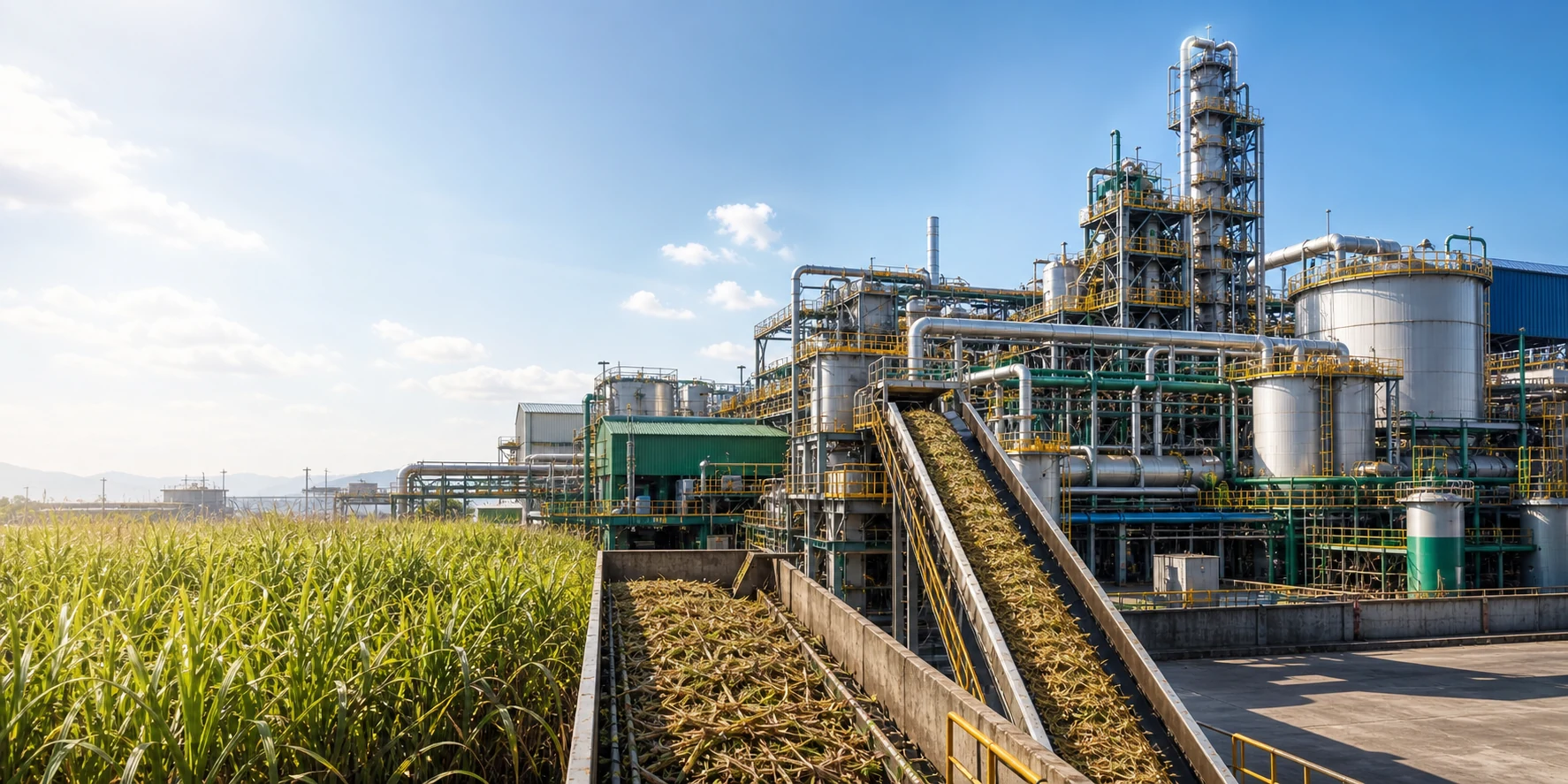
CHOOSE BY PROCESS
Start with your operating stage.
Open the programme details, or use the interactive process diagram below to explore the full system.
01
Mill / Process-Water Sanitation
Mill and juice-handling area
View Programme →02Clarification / Settling
Limed juice and clarification stage
View Programme →03Decolorisation
Clarification to syrup process zones
View Programme →04Evaporator / Pan Antiscalant
Heat-transfer and evaporation zone
View Programme →05Viscosity Reduction
Syrup to massecuite process zone
View Programme →06Antifoam
Application-dependent sugar-process zone
View Programme →07pH / Alkalinity Support
Typical programme review point
View Programme →08Utility Sludge Conditioning
Boiler and cooling-water utilities
View Programme →Everklin Living Process Platform
Sugar manufacturing process
Move from cane preparation to finished sugar and inspect the process zones where chemistry, cleaning and operating control intersect.

System overviewDeposit risk on sugar-process heat-transfer surfaces
Select any numbered process point to inspect its operating challenge and treatment context.
Process stages
Monitoring referencesNo live plant values are shown.
pHTemperatureBrixTurbidityScaling TendencyFoam Condition
+1 more
Microbial Condition
Sugar Processing Chemistry
Browse the complete range. Select an item to view its application and technical information on this page.
| Product / programme | What it does | Task / application | Pack formats | Details |
|---|---|---|---|---|
| AC-1 · AC-12 | A process-water and sanitation programme reference for the relevant mill and juice-handling context. | Mill / Process-Water Sanitation | Programme-specific review | View details AC-1 · AC-12 |
| SA | A process programme reference for clarification and settling review around limed juice and the clarifier stage. | Clarification / Settling | Programme-specific review | View details SA |
| DECOL-1 · DECOL-2 · DECOL-3 · DECOL-4 | A programme reference for selected juice, syrup, raw sugar or refinery colour-control context after process review. | Decolorisation | Programme-specific review | View details DECOL-1 · DECOL-2 · DECOL-3 · DECOL-4 |
| AS-PAN | A heat-transfer programme reference for reviewed scale-risk management around juice heat exchangers, multiple-effect evaporators and vacuum pans. | Evaporator / Pan Antiscalant | Programme-specific review | View details AS-PAN |
| VR | A process programme reference for reviewed syrup, vacuum-pan and massecuite context. | Viscosity Reduction | Programme-specific review | View details VR |
| AF | An application-dependent foam-control programme reference for reviewed sugar-process points. | Antifoam | Programme-specific review | View details AF |
| PHBH | A conservative process programme reference for selected sugar-process chemistry review. | pH / Alkalinity Support | Programme-specific review | View details PHBH |
| SLUDGE CONDITIONER - LIQUID · SLUDGE CONDITIONER - POWDER | A utility-side programme reference for boiler or cooling-water sludge-handling context, not direct sugar-process chemistry. | Utility Sludge Conditioning | Programme-specific review | View details SLUDGE CONDITIONER - LIQUID · SLUDGE CONDITIONER - POWDER |
Choose by task + programme details
Select a programme below to review its application, operating objective, selection information and available product references.
Mill / Process-Water Sanitation
OPERATING PROGRAMME
Mill / Process-Water Sanitation
A process-water and sanitation programme reference for the relevant mill and juice-handling context.
Cane preparation, milling and raw-juice handling context.
Support a documented review of the intended process-water or sanitation requirement.
Mill and juice-handling area
Selection considerations
- Actual process-water and sanitation context
- Approved operating procedure
- Current Sugar Processing documentation
Information normally reviewed
Actual process-water and sanitation context · Approved operating procedure · Current Sugar Processing documentation
Clarification / Settling
OPERATING PROGRAMME
Clarification / Settling
A process programme reference for clarification and settling review around limed juice and the clarifier stage.
Clarification selection depends on actual juice condition, process arrangement and reviewed treatment sequence.
Juice heating / liming, clarification and mud-filtration route.
Support a documented clarification and settling review.
Limed juice and clarification stage
Selection considerations
- Current process condition and available observations
- Clarifier and mud-filtration route
- Current programme documentation
Information normally reviewed
Current process condition and available observations · Clarifier and mud-filtration route · Current programme documentation
Decolorisation
OPERATING PROGRAMME
Decolorisation
A programme reference for selected juice, syrup, raw sugar or refinery colour-control context after process review.
Colour-control selection needs to map to the actual sugar-process zone and current programme evidence.
Clarification, clarified juice, syrup and selected downstream colour-control context.
Support a conservative technical review for the relevant colour-control requirement.
Clarification to syrup process zones
Selection considerations
- Actual process point and current operating context
- Related clarification or downstream process sequence
- Current technical documentation
Information normally reviewed
Actual process point and current operating context · Related clarification or downstream process sequence · Current technical documentation
Evaporator / Pan Antiscalant
OPERATING PROGRAMME
Evaporator / Pan Antiscalant
A heat-transfer programme reference for reviewed scale-risk management around juice heat exchangers, multiple-effect evaporators and vacuum pans.
The selected programme must relate to the real heat-transfer path rather than a generic antiscalant page.
Juice heat exchangers, evaporators and vacuum-pan process zones.
Support a documented scale-risk review for the selected evaporation or pan process.
Heat-transfer and evaporation zone
Selection considerations
- Actual heat-transfer equipment and process point
- Current process and operating evidence
- Current technical documentation
Information normally reviewed
Actual heat-transfer equipment and process point · Current process and operating evidence · Current technical documentation
Viscosity Reduction
OPERATING PROGRAMME
Viscosity Reduction
A process programme reference for reviewed syrup, vacuum-pan and massecuite context.
The programme should be selected against the relevant process condition without unsupported yield or performance claims.
Syrup, vacuum pan and massecuite stages.
Support a documented technical discussion around the selected process requirement.
Syrup to massecuite process zone
Selection considerations
- Actual process stage and operating context
- Related vacuum-pan or massecuite route
- Current programme documentation
Information normally reviewed
Actual process stage and operating context · Related vacuum-pan or massecuite route · Current programme documentation
Antifoam
OPERATING PROGRAMME
Antifoam
An application-dependent foam-control programme reference for reviewed sugar-process points.
Foam control is not assumed for every process; it is reviewed where the operating condition requires it.
Clarification, evaporation, syrup, vacuum pan or centrifugation context as reviewed.
Support an evidence-led discussion for the observed foam condition.
Application-dependent sugar-process zone
Selection considerations
- Observed foam location and process context
- Current operating procedure
- Current technical documentation
Information normally reviewed
Observed foam location and process context · Current operating procedure · Current technical documentation
pH / Alkalinity Support
OPERATING PROGRAMME
pH / Alkalinity Support
A conservative process programme reference for selected sugar-process chemistry review.
The relevant process point must be confirmed from current plant context; no injection point is assumed here.
Typical programme review point around raw juice, heating / liming and clarification.
Keep pH and alkalinity discussion connected to technical review rather than a hard-coded dose point.
Typical programme review point
Selection considerations
- Current sugar-process configuration
- Available process evidence
- Technical review before selection
Information normally reviewed
Current sugar-process configuration · Available process evidence · Technical review before selection
Utility Sludge Conditioning
UTILITY PROGRAMME
Utility Sludge Conditioning
A utility-side programme reference for boiler or cooling-water sludge-handling context, not direct sugar-process chemistry.
Utilities support the process but remain distinct from the main cane-sugar process flow.
Separate boiler / steam and cooling-water utility systems.
Connect sugar-mill utility context to the authoritative Water Treatment flagship systems.
Boiler and cooling-water utilities
Selection considerations
- Actual utility system and solids-handling route
- Current utility operation context
- Technical review with the relevant Water Treatment programme
Information normally reviewed
Actual utility system and solids-handling route · Current utility operation context · Technical review with the relevant Water Treatment programme
Technical reference
System context, selection and operating evidence.
Use these concise references alongside the Living Process. Final product, controller, cleaning or dosage decisions require current technical information and site-specific review.
01System Fundamentals+
The sugar process moves from cane preparation and juice extraction through heating, clarification, evaporation, syrup, vacuum pan, crystallisation, centrifugation and storage. This workspace connects Everklin programme references to those process zones. It keeps boiler and cooling-water utilities separate and linked to their dedicated Water Treatment systems.
Cane and raw juiceStart with cane preparation, milling, process-water and raw-juice handling context.
Heating and clarificationKeep liming, clarification, settling and mud filtration attached to the actual juice route.
Heat transfer and evaporationReview heat exchangers, evaporators and pan surfaces in their operating sequence.
Syrup and vacuum panConnect syrup, viscosity, foam and crystallisation context to the selected process stage.
Centrifugation and final handlingKeep downstream process observations separated from upstream clarification and heat-transfer decisions.
UtilitiesRefer boiler and cooling-water needs to their authoritative Water Treatment system pages.
02Selection & Diagnostics+
A responsible sugar-process review connects the selected process zone, current operating evidence, related equipment and current programme documentation before a reference is discussed.
A. Process stageCane, juice, heating, clarification, evaporation, syrup, pan or downstream stage / Relevant process equipment / Current operating observations
B. Process conditionCurrent application context / Related treatment route / Available process evidence
C. Utility boundaryBoiler or cooling system where relevant / Separate Water Treatment system context / Approved utility programme documentation
D. DocumentationCurrent programme reference / Available technical information / Need for a process review
03Monitoring & Operating Data+
The observations that matter depend on the chosen sugar-process zone, current operating procedure and the information available for technical review.
Process zoneSelected sugar-process point / Relevant process equipment / Current operating observation
Treatment contextRelated process sequence / Existing programme reference / Available technical documentation
Utility boundaryBoiler context where relevant / Cooling-water context where relevant / Dedicated Water Treatment route
Follow-upProcess review questions / Current operating records / Technical-document request
04Documents & FAQ+
Programme references and technical documentation are requested with the selected sugar-process context so the right operating zone remains clear.
Current TDS, SDS and programme documents are coordinated during the single technical review below.
Why is the process zone important in Sugar Processing?
Clarification, evaporation, syrup and crystallisation have different operating context, so programme discussion starts with the actual process point.
Are boiler and cooling programmes included in Sugar Processing?
They remain separate Water Treatment systems and are linked through their dedicated Boiler Chemicals and Cooling Tower Chemicals pages.
Can an antiscalant reference be used without reviewing the equipment?
No. Heat-transfer and pan context should be confirmed against the actual equipment and operating condition.
Why are colour and viscosity references separated?
They are discussed against different process conditions and need the correct syrup, pan or downstream context.
Request Technical Review
Request Technical Review
Review the operating context before programme selection.
Share your operating conditions, current treatment context and available process or water data. Everklin's technical team can review the relevant programme.