
Site Assessment
Our technical team reviews current products, dilution practices and any recurring issues (staff irritation, odour complaints, inconsistent results) before recommending anything.
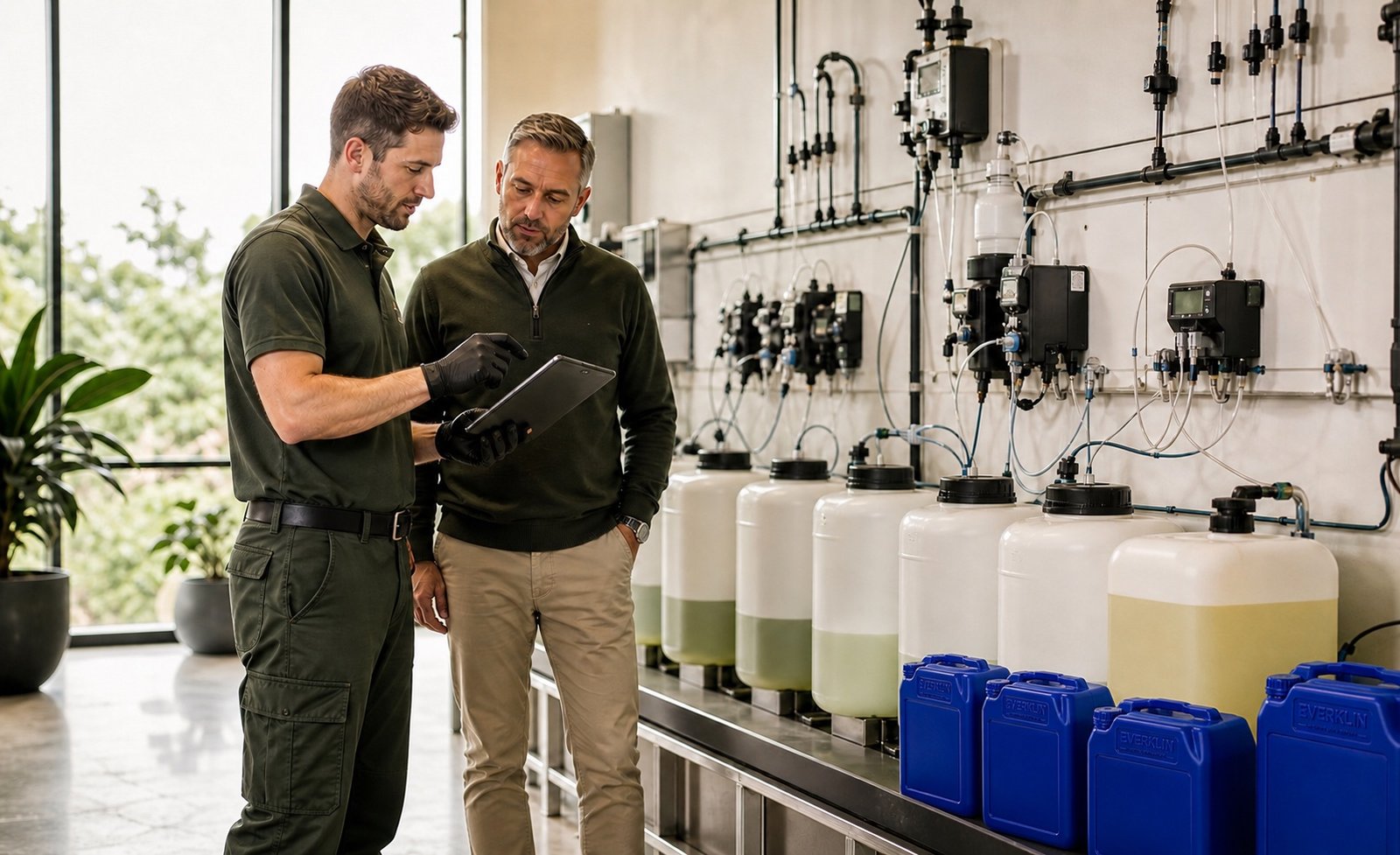
Switching to certified, safer cleaning chemistry works best as a staged process, not an overnight change. Here's how our technical team typically approaches it.
2 min read
Our technical team reviews current products, dilution practices and any recurring issues (staff irritation, odour complaints, inconsistent results) before recommending anything.
Products are matched to the specific application — hospitality, healthcare, food processing, water treatment and others each have different priorities, covered in our facility-type guide.
Rather than a full-facility switch on day one, we recommend piloting in a single, contained area with clear before/after tracking.
Correct dilution and application training is provided alongside the product — this is often what determines whether a transition actually delivers the expected results.
Once the trial results are reviewed against your own facility's numbers, the programme is rolled out to the wider site with ongoing technical support.
Cleaning chemistry interacts with local water hardness, existing surfaces, staff habits and dosing equipment — a product that performs well in one facility can behave differently in another. A staged trial gives you real numbers from your own site before committing budget and staff time to a full rollout, and it gives our technical team a chance to fine-tune dilution and application before scale.
Current product documents and certification details are available through Everklin's controlled request workflow. See our certifications page for the 12 GreenPro Certified Products, 10 GRIHA Certified Products and ISO 9001:2015 scope. We do not publish specific client results without permission; sector references can be discussed during a technical consultation.
Connect facility guidance to the operating area, task and current product documentation.
Talk to our technical team about a staged transition plan suited to your facility.